



Every year the same ritual plays out in so many companies: Marketing submits its budget requests for the coming fiscal; Finance pokes holes in it; the CEO trusts Finance on these matters more than Marketing and assigns a budget and targets that Marketing must meet. Marketing feels hard pressed to meet those numbers; not enough budget and too much of a stretch target.
This negotiation could benefit from a little more science. Predictive models of the kind that power more advanced versions of MMM are now capable of forecast accuracy that makes it possible to better understand the impact on the business of marketing activity (paid, owned, earned media and other drivers) and look out into the future covered by the marketing budget. We can ask what sales (or other measures of success related to brand and business growth) we could expect at different budget levels.
Let’s look at an example of such a model being used to set a marketing budget. We will start with the efficiency frontier:


We have built a model capable of predicting sales for the coming fiscal year. We use that model to simulate what sales would be at different budget levels. What we see is that sales rises as budget increases, but at a decreasing pace. For each budget increase, sales rises by a lower percentage, giving us this flattening effect.
Now, let’s calculate the Marketing ROI for each budget scenario. It would look like this:

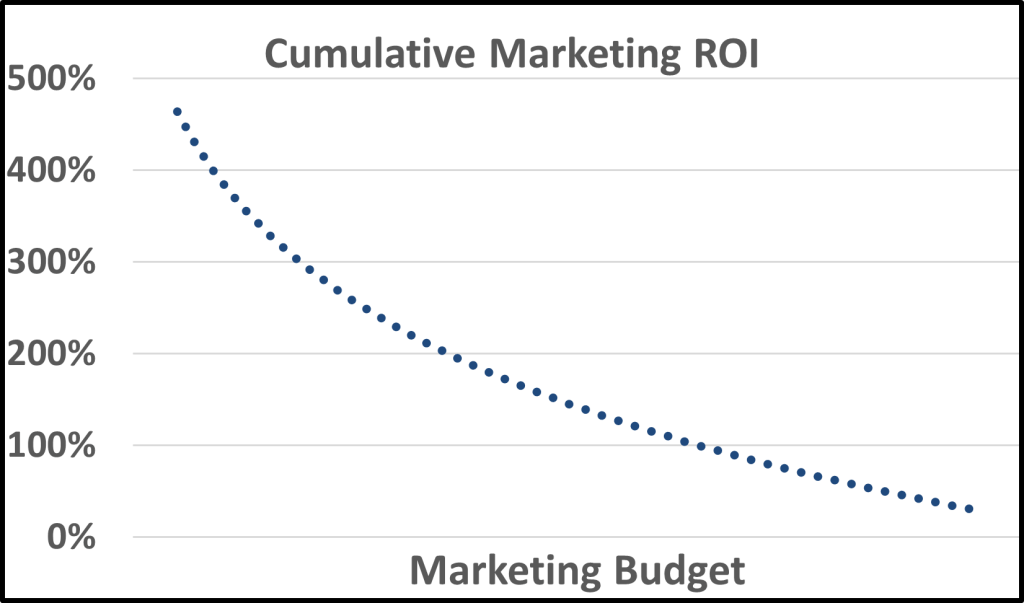
The first thing to notice is that as we increase budget, Marketing ROI falls. This is why we dont actually want to “maximize marketing ROI” as you may have heard some say. The highest ROI in any reasonably managed system of marketing activity occurs at the lowest budget levels. “Maximizing marketing ROI” is a good way to shrink a business.
Marketing ROI is not a goal; it is a constraint. We want the benefits of marketing actions to exceed their costs; to make a positive contribution to business profits. As we add budget, we would inevitably spend it on less and less productive actions, which gives us a diminishing return curve.
So how do we use this approach to set marketing budgets? Let’s now consider marginal marketing ROI.…the ROI of the increase in spend from one scenario to the next highest spend, in relationship to the sales over that span. That curve for this data looks like:


Notice that at one point, adding budget returns a negative ROI.

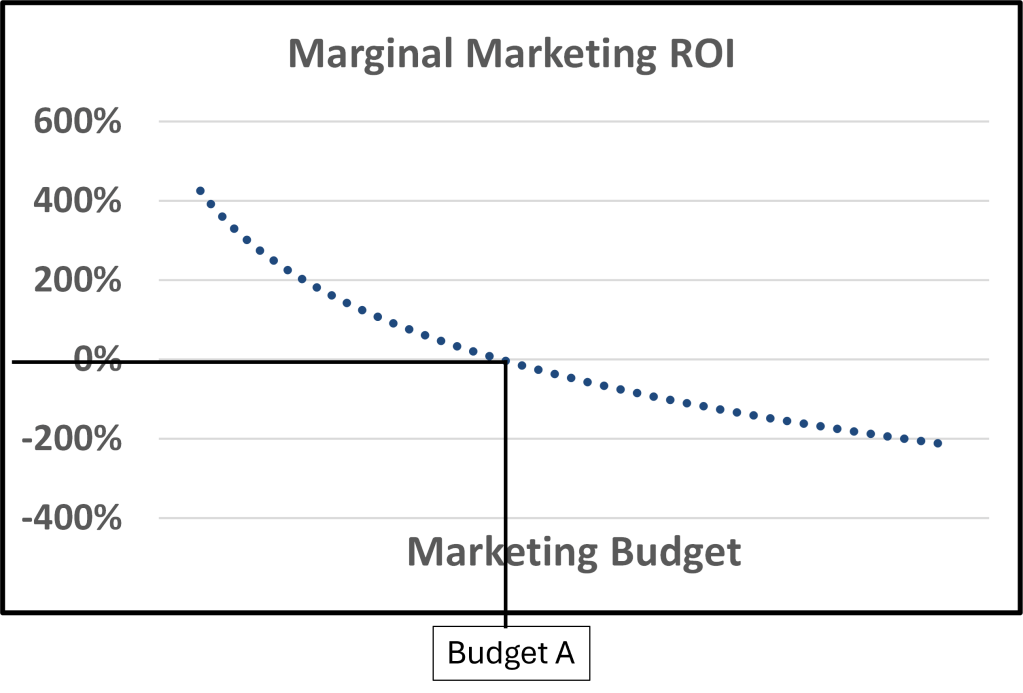
At Budget A, marketing ROI is at break even for the spend between that scenario and the next lowest. If we increased budget further, we would lose money on those additional activities…something we want to avoid.
At Budget A, marketing’s contribution is at its maximum for this forecast period, and for the market dynamics currently in play, according to the model.
Let’s put all three graphs together to see the dynamic more clearly:


Key points:
- Higher marketing ROI’s are found at lower sales levels than Budget A. Chasing higher marketing ROIs results in lower sales; not good for the brand or the business.
- Increasing budget above Budget A results in losses on those additional budgets, even though overall, marketing ROI is still positive (until some point where the losses on these additional sales offsets all the gains on sales up to that point. At an extreme, additional budget may result in no sales increase at all.). A brand could still decide they want to spend above Budget A, to buy share, for example. With this type of analysis they would know how much that increased sales number is really costing them.
Based on our experience, most marketers spend well below the level of Budget A….missing a lot of opportunity to grow the brand and the business.
Taking this approach requires that the modelling be of sufficient accuracy and reliability.
That is, the model is…..
- Built around C suite goals, not marketing vanity metrics…
- …taking a holistic approach to the data used, covering all of the major drivers of business outcomes…
- …at a level of accuracy that reduces the chances of bad decision making (see Will that model get you promoted? Or fired? (Part 1))…
- ….has been tested and validated to the satisfaction of the C suite.
Budget battles could be a lot less rancorous and lead to a much larger contribution to brand and business goals if both Marketing and Finance could agree on how the frontier is to be measured and how to use this knowledge to maximize marketing’s contribution to growth.