In analytics, we often talk about the quality of the work….is it a good model, sound research, etc. But we need to talk more about how brand leaders make decisions…what they do with evidence once they have it.
We have all been around lousy outcomes. Those are uncomfortable times for leaders. Been there, done that. But what we learn then….or what we learn from our successes….will go a long way to shaping our future success, or lack of it.
Decision science research supports the value of structured reflection. Yet too often, we judge decisions by their outcomes.
A good decision can produce a poor result. A bad decision can succeed through luck. Confusing the two means learning the wrong lessons.
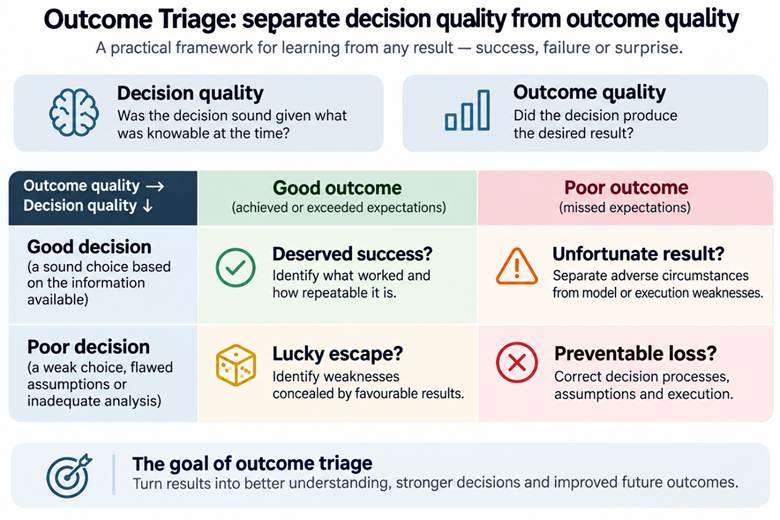
I call the alternative Outcome Triage.
It starts by separating decision quality from outcome quality. Was the original decision sound given what we knew? What actually happened? Why? What assumptions proved wrong? What consequential differences did we overlook?
And, most importantly, what will we do differently next time?
This isn’t about assigning blame. Nor is it just another performance review. It’s about turning experience into better judgment.
The accompanying matrix illustrates four situations, each offering different lessons. Success deserves scrutiny just as much as failure.
The real test of leadership isn’t simply making good decisions. It’s becoming better at making them.
Not because marketing needs another way to pay agencies, but because it may offer a better way to manage — and share — marketing risk.
Consider two risks.
Opportunity risk.
A company sees a growth opportunity, but uncertainty makes it difficult to secure enough capital to pursue it.
The opportunity remains underfunded.
For some businesses that means slower growth. For a challenger trying to establish scale — or a company facing rapid market change — repeatedly failing to fund the right opportunities can become a strategic, even existential, risk.
Then there is execution risk.
Capital gets approved, but the marketing system is suboptimized. Channels, audiences, markets and timing don’t work together as effectively as they could.
Results disappoint.
Capital gets burned. And a visible failure can damage Marketing’s credibility and the organization’s confidence in the next investment.
Which raises a different question:
Could advertisers and their marketing partners manage some of these risks together?
Agencies bring strategy, creativity, media expertise and increasingly sophisticated technology.
Specialist partners, like us, can add predictive analytics, optimization, incrementality measurement — and, in some cases, capital.
Put those capabilities together and a different commercial model becomes possible.
If we can identify an opportunity, predict its incremental value, optimize how it is pursued and independently verify the result, compensation can increasingly be tied to the business outcome.
And where the evidence is strong enough, partners may even choose to share some of the investment risk.
Now outcome-based pricing becomes more than a compensation model.
It becomes a risk-sharing mechanism.
That could help address both sides of marketing risk:
Fund more of the opportunities worth taking. Reduce the risks.
Now, advertiser, agency and specialist partners can all have more of their economics connected to the same objective:
Creating incremental business value.
Perhaps that is the bigger opportunity in outcome-based pricing.
Not replacing the agency model.
Giving agencies and advertisers another way to grow together — with greater alignment around both risk and reward.
Understand the risk. Manage the risk. Share the risk.
We’ve spent years getting better at measuring return. I’m not sure we’ve become nearly as good at measuring risk.
And that matters.
When a marketing investment goes badly, the obvious loss is money. But poor risk management can burn much more than capital.
Capital gets burned when investment fails to produce sufficient incremental return.
Credibility gets burned when a major miss leaves Marketing struggling to explain what happened — or why the risk was worth taking.
Confidence gets burned when the CFO, CEO or Board becomes less willing to back the next marketing investment.
And opportunity gets burned when potentially profitable growth goes unfunded because Marketing cannot quantify the risk well enough to justify the capital.
That last one may be the least visible — and potentially the most expensive.
Importantly, a bad outcome doesn’t necessarily mean the risk was badly managed. A well-considered investment can fail, and a poorly considered one can get lucky.
The better question is what we knew before we committed the capital.
What was the range of possible outcomes?
How likely were they?
What was the downside?
How much capital should we put at risk?
And what was the risk of not investing?
Marketing has made enormous progress proving what happened after the money was spent.
Perhaps the next challenge is getting much better at deciding what risks are worth taking before we spend it.
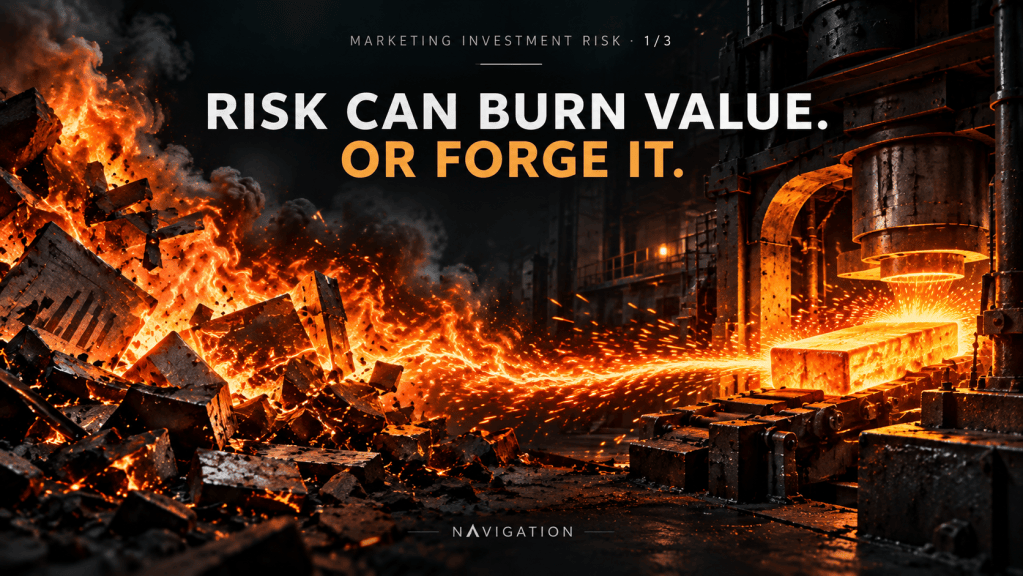
We can think of risk by using fire as an analogy.
Uncontrolled, it can burn value. Understood and managed, it can forge it.
When we first wrote about the Six Foundations, we approached them largely as requirements for building a model properly. But if you lead a brand, the more important question is: why does this matter to me?
Each foundation exists for a business reason. In developing the Six Foundations, if we could not explain what better decision a foundation enabled and how that decision could improve a business outcome, we dropped it from consideration.
Seen this way, the Six Foundations aren’t simply characteristics of a good model. They are requirements for turning better understanding into better business performance.
We start with what the business is trying to accomplish, rather than with the data we happen to have or the marketing metrics we traditionally measure.
What does management want to change? Revenue? Profit? Customer growth? And what decisions could change that outcome?
This puts marketing into a more useful capital-allocation conversation. Instead of asking how much budget marketing should be allowed, we can ask:
How much should we invest given the incremental returns available?
That’s a question the CMO, CFO and CEO can answer together.
2. Holistic Design: Find All the Levers
Advertising doesn’t operate in isolation. Sales also move because of price, distribution, competitors, economic conditions, customer behaviour, geography and many other factors.
Accounting for these improves attribution. But the larger benefit is that we learn more about what actually moves the business.
One example is baseline dynamics. We can examine the underlying trajectory of the business and how it varies across markets and over time. We have seen advertising perform better in times and places where the baseline is strengthening than where it is weakening.
That gives us another lever for growth.
The objective isn’t simply better attribution. It is better understanding of the business and more ways to improve it.
3. Predictive Accuracy: Know Before You Go
Explaining what happened is useful. Predicting what will happen is much more valuable.
If management is considering another large investment, we want to predict the incremental outcome, where that investment should go, and whether another course of action would produce more.
We want to know before we go.
The more accurately we can predict the consequences of alternative actions, the less uncertainty surrounds the investment decision.
Accuracy creates confidence. Confidence moves money. Outcomes provide proof.
This is especially important when the problem is underinvestment. If management doesn’t know what another dollar will produce, being conservative is rational. Better prediction can change that calculation.
4. Actionability: Capture the Opportunity
Finding an opportunity isn’t the same as capturing it.
A model needs to operate where decisions can actually be changed — by geography, audience, channel, timing, investment level or other controllable variables.
It also needs to recognize that decisions interact. A media opportunity doesn’t have a fixed value. Its value depends partly on what else the advertiser is doing.
This means we can have individually optimized search, television and CRM programs and still have a suboptimal overall plan.
The objective isn’t to optimize every component independently. It is to find the combination of decisions that produces the best business outcome.
This also has implications for model design. We need to understand how each channel is actually planned and bought, and build the model at a level that allows the best combination of actions we identify to actually be executed.
5. Independent Testing: Earn Confidence
We shouldn’t trust a model simply because it explains historical data well.
Confidence needs to be earned.
That means testing against data the model wasn’t built on, testing predictions forward and, ultimately, comparing predicted incremental outcomes with what happens when the recommended action is actually taken.
Predict. Act. Observe. Test. Learn.
That also creates continuous improvement. Every action produces new evidence. Where prediction and outcome differ, we learn and improve.
For management, this creates a sensible path to scale: start, test, learn and put more capital behind the system as the evidence earns greater confidence.
6. Leverage: How Much Better Can We Make the Business?
This may be the most important question of the six.
Imagine an extremely accurate model that passes every test but discovers the business is already operating close to its potential.
It is a good model. But it hasn’t uncovered a particularly valuable opportunity.
Now imagine another model that identifies a substantial difference between what the organization is doing and what it could be doing.
Perhaps money is allocated to the wrong places. Geographic variation isn’t being exploited. Activities that work particularly well together aren’t coordinated. Timing could be improved.
Or perhaps the biggest opportunity is that the business should simply invest more.
That difference between the expected outcome from continuing as we are and what could be achieved through better decisions is leverage.
Marketing analytics has traditionally emphasized efficiency: How can we make the existing budget work harder?
That’s important, but it isn’t necessarily the most valuable question.
Suppose a business spends $50 million and we find a way to make that $50 million produce more. We have created value.
But suppose the evidence shows it should spend $70 million because the next $20 million can produce an attractive incremental return.
Not investing that money also leaves value on the table.
The constraint shouldn’t automatically be today’s budget.
The objective should be the best business outcome.
The Question That Ultimately Matters
The Six Foundations can therefore be reduced to six questions:
Are we solving something important?
Do we understand what is really driving the business?
Can we accurately predict what will happen?
Can we act on what we learn?
Have we independently tested our predictions?
And finally:
How much better can we make the business?
The first five establish our ability to answer the sixth.
Because the objective isn’t to build the most sophisticated model, or even simply to measure marketing more accurately.
It is to use better understanding, prediction and decision-making to find, value, prove and capture opportunities to improve the business.
That is what a Six Foundations model is designed to do.