
Is the annual budgeting ritual holding your brand back?

The annual budget setting exercise is a rite of passage for every marketer once they become responsible for a budget, in most companies.

While they vary in practice, most have a common structure: Marketing works up a budget based on historic performance plus a wish list of projects they want to fund for the coming year.  For some companies, there are many marketing teams doing this workup. It will be up to the CMO to consolidate these and negotiate with the CFO and CEO for approval.

At the C suite level marketing’s plans and projections are important, but so are budget requirements from other teams across the enterprise.  Now the competition begins; who gets funded, who comes up short.

All of this is based on what is known at the time budget decisions are set.  For many companies, once the budget is set, it is set like hard concrete.  Woe be the manager who misses target or who is at risk to over-spend due to factors that could not have been known at the time the budget concrete was poured.  Media inflation, unexpected increases in costs, supply shocks in the value chain, they all have the potential to disrupt the best laid plans.

As the year unfolds, the concrete can create more problems:

  • If a new opportunity arises, and it inevitably does, marketing is forced to cut budgets where it does not want to in order to fund the new.  Why cut something that continues to look like it contributes to profitable growth?
  • Imagine that some of the things being tested in the previous year are returning much better results than status quo.  They should be rolled out, but can they be without cutting other productive projects?
  • Sometimes the market trends so favourably that a bright future is there for the taking….if marketing has the budget to exploit it.  If they don’t, the favourable tail winds may do more for competitors.
  • Predictive models, if sufficiently accurate and reliable, can show upside opportunities from those budgeted.  Are you able to take advantage?

Think of a fixed budget as a barrier to opportunity:
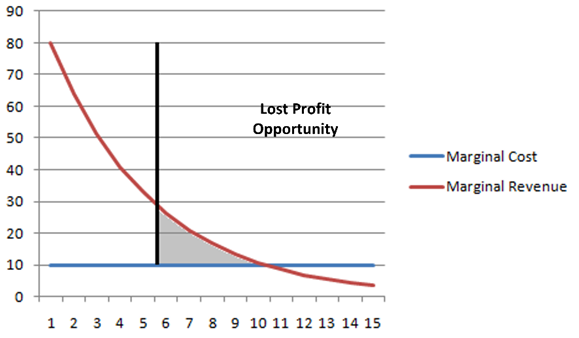
As budget rises, marginal revenue should as well, but on a diminishing curve.  For businesses with relatively fixed marginal costs, there will come a point where marginal costs exceed marginal revenue; this point represents the maximum contribution marketing can make to sales over this period.

But a fixed budget typically, in our experience, falls well short of this, leaving the brand/company with a lost profit opportunity, shown here as the grey area on the graph.

What can be done?

Consider building some agility into the budget process instead.  Instead of targets and budgets set in concrete for a year, there is the recognition that things change (for better or worse) and so should the budget.

Agile budgeting can incorporate contingency funding, flex targets, outcome-based opportunity funding, or rolling budgets over shorter time horizons.  Each has its strengths and weaknesses.  But before they are considered, you should decide if your annual budget process is holding you back, and by how much.  It might be time to lose that ball and chain.

Want to reduce churn?  Don’t model churn.

At least, don’t model churn as your only step.

A very common approach to churn reduction is to build predictive models, which are intended to produce a score for the likelihood a customer will churn within a given time period.  The approach is so common there are libraries of code available online for this purpose.  ChatGPT can provide Python code for the task.

But is it the right thing to do? 

We have been helping marketers reduce churn for over 20 years.  In our experience, predicting churn is a good first step, but you cannot stop there.

You actually want to predict not just churn risk, but the probability you can save the relationship, given your history of communication and offers used for this purpose. 

The highest churn risk scores may be pointing you to customers that are more than halfway out the door anyway.  Not only will your communications and offers not dissuade them…it’s too late…it might actually make things worse.  There is a “wake up” effect we have seen where at-risk customers realize their contract is up for renewal, for example, and it’s time to shop around, not jump at your first offer.

Think recovery, not just risk.

Next, think about the value of the relationship.  What is the predicted lifetime value in the coming years, after your planned intervention?  How long will they stay with you, what revenues would you predict over that period, and at what profit margins?  Knowing this number gives you the starting point for a key question: what are you prepared to spend to save this relationship? 

Extrapolate that question across all risk-save scores and you get a sense of the envelope of budget you need to reduce churn, as well as a sense of how much of a dent you can make in the churn rate.

Another way to think about churn reduction is as a problem in optimizing individual contacts….what offer, message, channel and timing.  This is where a product like our 1:1 Optimization system can help direct traffic and make both planning and execution easier.

Finally, you probably don’t have a churn problem (what??).  You probably have several.  Customers don’t all leave for the same reason, and a tactic designed to keep them for one irritant may be completely irrelevant, even counterproductive for another. 

Consider an example from wireless services.  What if a customer is irritated about billing problems, not resolved with your customer service team, repeatedly?  Consider another customer who is irritated about dropped calls.  What can you do to counter these two problems?  Would the same tactic work for both?  Would a tactic designed to work well for one be as effective for the other?

You should think about a modelling solution that provides risk scores, save scores, and what we call Action Codes.  Action codes combine an evaluation of why a customer is at risk with an action you choose to suppress that risk.  All three scores can be funnelled to the customer-facing systems you will use to deliver messages, whether that is an all purpose CRM system, a channel focused system such as for email, or other.

Put it all together and you have the answers you need to plan effective churn programs and translate strategies into individual action plans.

Best of luck and if we can help, don’t hesitate to contact us.